Super Early Deadline
31 August 2026
Judging
Date
22 & 23 March 2027
Winners Announcement
22 April 2027
31 August 2026
22 & 23 March 2027
22 April 2027
There are few winery origin stories as improbable — or as memorable — as Spy Valley Wines.
Long before the estate became one of New Zealand’s most recognised premium wine producers, the Waihopai Valley in Marlborough was considered a gamble. Dry, isolated, and relatively undeveloped, the area lacked the viticultural confidence that now defines modern Marlborough. Yet in the early 1990s, family patriarch Bryan Johnson and viticulturist Pete Masters decided to take a chance on the land.
Both men, by their own admission, were “mavericks.”
What followed was not simply the planting of vineyards, but the creation of one of New Zealand wine’s most distinctive identities — a producer that has managed to balance serious winemaking credentials with a sense of humour, intrigue, and unmistakable personality.
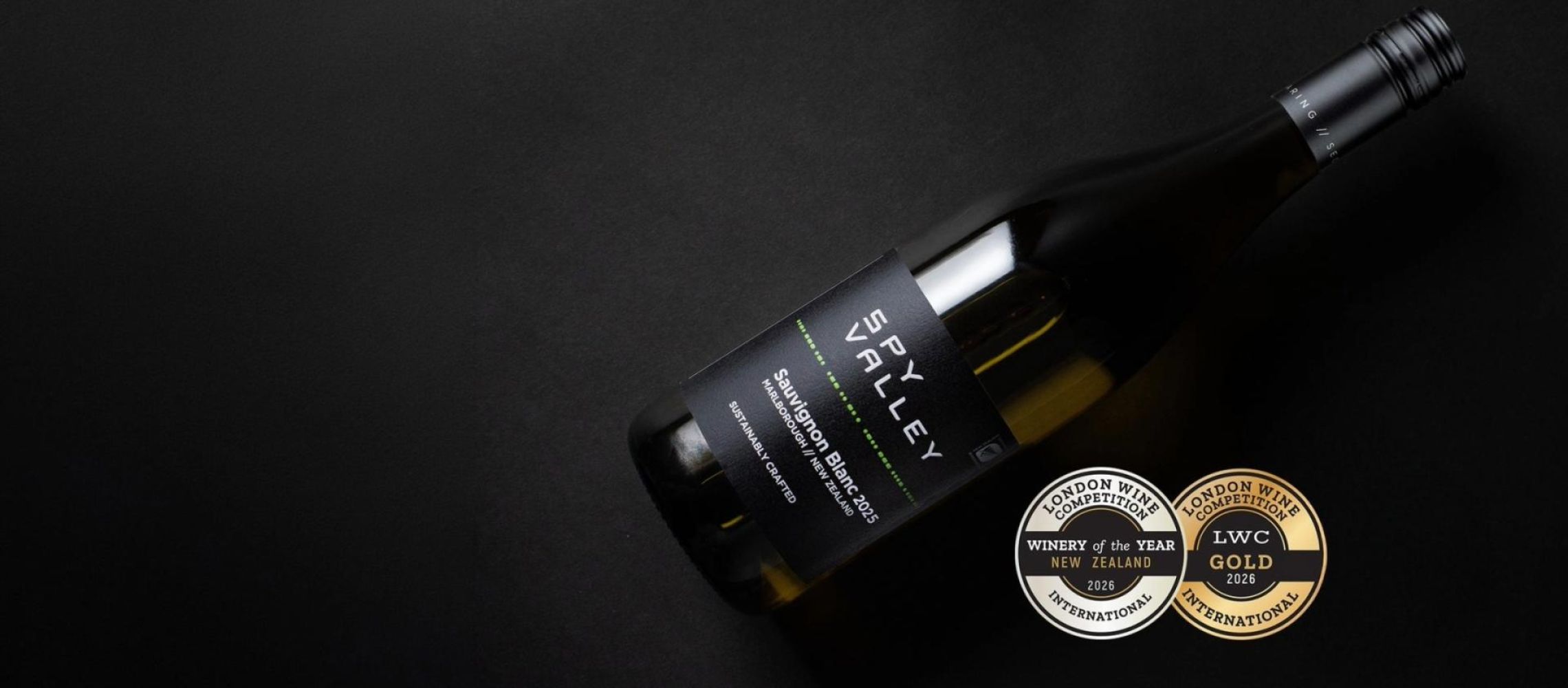
Today, Spy Valley Wines exports to more than 35 countries and has just been named New Zealand Winery of the Year at the 2026 London Wine Competition, alongside an extraordinary medal haul that included seven Gold Medals across its portfolio.
For a winery born out of risk-taking, the recognition feels particularly fitting.
The story begins with geography — and espionage.
In the 1980s, the New Zealand government established a satellite listening station in the Waihopai Valley, part of the international Five Eyes intelligence alliance involving New Zealand, the UK, the United States, Canada, and Australia. Locals jokingly nicknamed the region “Spy-hopai Valley,” a detail that would eventually shape the winery’s future.
At the time, the Johnson family were grape growers supplying fruit to Corbans, then New Zealand’s largest locally owned winery. But when Bryan Johnson’s daughter Amanda returned to Marlborough, she pushed the family toward creating their own label. Rejecting traditional winery naming conventions, she proposed something more playful and culturally rooted: Spy Valley.
Legend has it she cornered her parents in bed with a PowerPoint presentation to make her case.
The gamble worked.
Today, the brand’s spy-inspired identity has become central to its global appeal. The winery leans into themes of intrigue, mystery, and mission-like precision, creating a marketing narrative that feels genuinely organic rather than artificially constructed.
But behind the clever branding lies a deeply serious wine operation.
The Waihopai Valley itself plays a defining role in the style and quality of Spy Valley’s wines. Protected within the rain shadow of the Richmond Ranges, the sub-region experiences lower rainfall, clearer skies, warmer daytime temperatures, and cooler nights than much of broader Marlborough. Combined with gravelly ancient riverbed soils and free-draining alluvial topsoil, the conditions naturally restrict vine vigour and lower yields.
The result is Sauvignon Blanc with concentration, tension, and textural depth.
Where some Marlborough Sauvignon Blancs can veer toward overt pungency or aggressive herbaceousness, Spy Valley’s wines consistently lean toward greater fruit precision and structure. Tropical fruit, citrus, stone fruit, and minerality are delivered with clarity while retaining the acidity that has made Marlborough globally famous.
The judges at the 2026 London Wine Competition repeatedly highlighted that balance.
Spy Valley Sauvignon Blanc earned a Gold Medal with 92 points for its bright citrus and green apple character balanced by restrained herbaceous notes and clean acidity. Spy Valley Sauvignon Blanc First Release also secured Gold, praised for its plush texture, melon and quince aromas, and harmonious fruit concentration. Meanwhile, Satellite Sauvignon Blanc and Kimi Sauvignon Blanc reinforced the winery’s ability to deliver quality across multiple tiers and stylistic expressions.
Yet perhaps the most significant recognition came through Envoy Johnson Sauvignon Blanc, which received a Gold Medal and 93 points.
The Envoy range represents Spy Valley’s ambition to challenge assumptions around New Zealand Sauvignon Blanc altogether.
Rather than focusing purely on freshness and immediacy, Envoy explores texture, complexity, and site expression through oak influence, hand-harvested fruit, and carefully selected Bordeaux clones. The wine demonstrates that Marlborough Sauvignon Blanc is capable not only of youthful aromatics but also of sophistication and ageing potential.
For Spy Valley, that evolution has been intentional from the beginning.
“We wanted to showcase the versatility of Sauvignon Blanc,” the winery explains, “demonstrating there can be a Sauvignon Blanc style for everyone.”
The estate’s naturally high acidity and concentrated fruit profile provide the structural backbone necessary to support greater winery intervention without losing varietal identity. Extended hang times during the 2023 vintage further enhanced flavour concentration and palate weight while maintaining freshness and balance.
That pursuit of precision begins in the vineyard.
Spy Valley remains fully vertically integrated, with control spanning from vine to bottle. The estate’s proximity to the winery allows fruit to be harvested precisely when flavour development reaches its ideal point. Regular vineyard tasting, careful site selection, and an uncompromising attitude toward flavour concentration underpin the winemaking philosophy.
“If the flavour isn’t present in the vineyard, it will not appear in the wine,” the team states plainly.
The winery’s use of Bordeaux Sauvignon Blanc clones adds another layer of complexity, contributing riper citrus, blackcurrant leaf character, minerality, and ageability. Some of the vineyards date back to the 1990s — considered relatively old vine territory by Marlborough standards — giving additional concentration and depth to the wines.
Importantly, Spy Valley’s success has not come at the expense of sustainability.
Certified under Sustainable Winegrowing New Zealand since 1999, the estate has continually evolved its environmental practices beyond baseline certification standards. Herbicide use has been significantly reduced in favour of maintaining natural under-vine growth, encouraging deeper root systems and greater drought resilience. Sheep graze vineyards during winter, naturally controlling vegetation while reducing diesel usage and soil compaction. The winery was among the first in the region to install solar panels, and all still wine bottles weigh under 400 grams to minimise transport emissions.
Spy Valley has also partnered with Ecologi to invest in emissions reduction and nature restoration initiatives, reinforcing sustainability as a practical operational philosophy rather than simply a communications exercise.
For international buyers, the winery’s appeal lies in its ability to combine all the key pillars modern premium wine markets demand: strong provenance, clear regional identity, sustainability credentials, family ownership, export reliability, and critically, wines that overdeliver at multiple price points.
Despite its global reach, Spy Valley remains firmly family-driven. The Johnson family continues to oversee the business, maintaining long-term relationships with importers and distributors while carefully controlling growth.
“We never want to grow if it dilutes what we make,” the winery says.
That mindset may explain why Spy Valley continues to resonate so strongly in international markets. In a crowded category where many producers rely solely on Marlborough’s reputation, Spy Valley has managed to build something far more enduring: a brand with genuine personality, a sense of place, and a clear point of difference.
Not bad for a winery born beside a spy station in a valley many once thought impossible to farm.
The 2026 London Wine Competition results are out — explore the winners and maximise your success. View Results | Order Stickers | Marketing Add-Ons